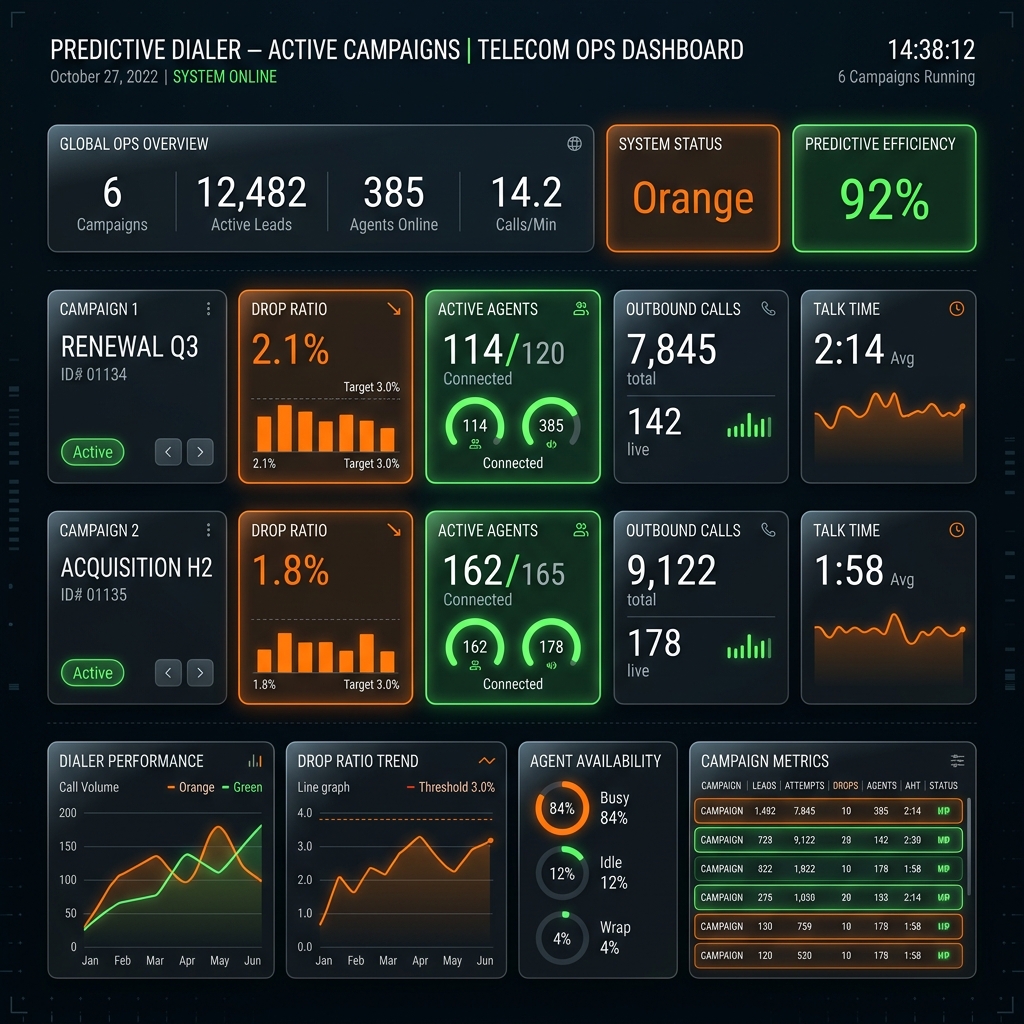
Outbound dialing has evolved from basic autodialers into highly sophisticated telemetry platforms driven by predictive statistics. Today, predictive dialers are critical tools for high-volume customer contact floors, helping agents maximize active talk time while staying compliant with strict drop-rate caps.
But how do these dialer engines know exactly when and how many calls to place simultaneously? The answer lies in probability theory, queue optimization, and real-time parameter tracking.
"Predictive dialing is an engineering balance. We must project human behavior mathematically to optimize agent occupancy without dropping customer connections."
The Pacing Ratio Formula
The core objective of a predictive dialer is to minimize agent idle time. If a system only dials one number per idle agent, agents will spend the majority of their day listening to ringing lines, busy signals, or voicemail recordings. To solve this, predictive dialers dial multiple lines simultaneously for each agent.
The number of concurrent calls to make—known as the pacing ratio—is calculated using a probability equation that factors in the probability of a call being answered ($P_{answer}$), the average talk time ($T_{talk}$), the average wrap-up time ($T_{wrap}$), and the number of active agents in the pool ($N$).
Using Erlang-C queue formulas combined with real-time statistics, the system estimates when an agent will finish their current call. If $P_{answer}$ is 20% (meaning only 1 in 5 dialed calls is answered by a human), the system will dynamically dial 5 calls for every agent projected to become available in the next 15 seconds.
Enforcing compliance limits
Dials must be capped carefully. Under federal TCPA regulations, if a dialer connects with a customer but no agent is available to answer within 2 seconds, the call is classified as a "dropped call" or "abandoned call." Regulations dictate that the monthly call abandonment rate must not exceed 3%.
To avoid breaching this cap, our dialer runs a continuous feedback loop. If the active drop rate approaches 2.5%, the system immediately reduces the pacing ratio, reverting to a safer progressive dialing mode until the statistics recover.
Key Mathematical Inputs
- Probability of Contact ($P_c$): Calculated dynamically based on historical answer rates for the target time-of-day.
- Average Handle Time (AHT): Combined talk time and wrap-up time tracking.
- Erlang Queue Models: Predict agent queue occupancy statistics under heavy arrival patterns.
Conclusion
By implementing real-time pacing models and strict compliance checks, predictive dialers convert outbound calling from guesswork into a precise mathematical discipline. The result is a call center that operates at peak productivity while maintaining complete compliance.